Caring for your bike properly: the complete checklist for a longer life
In short: Whoever cleans and oils the chain every 2–3 weeks, checks tyre pressure and parks the bike dry doubles the life of the wear parts. Once a year to the workshop for an inspection: the cheapest insurance against expensive follow-up damage.
A well-cared-for bike lasts longer, rides better and saves on repairs. Many Berliners only bring their bike to the workshop when it rattles or the brakes don't work, even though most problems can easily be avoided with regular care. Here is our practical checklist.
Inspection or full clean?
Inspection from €29.95 (with partial cleaning), €39.95 (with full cleaning). Friesenstraße 24, Berlin-Kreuzberg, mornings without an appointment.
Mo–Sa 9–21 Uhr · 5.0 ★ · Over 750+ Google reviews
Care intervals at a glance
| Task | How often | Who |
|---|---|---|
| Check tyre pressure | Every 2 weeks | DIY |
| Clean & lubricate chain | Every 300–500 km / monthly | DIY |
| Test lights | Weekly in winter | DIY |
| Retighten bolts (saddle, bars) | Monthly | DIY |
| Check brake bite point | Monthly | DIY |
| Measure chain wear | Every 1,000–2,000 km | Workshop (free) |
| Full inspection | 1× per year | Workshop |
| Replace brake pads | As needed | Workshop |
| Bleed hydraulic brakes | Every 1–2 years | Workshop |
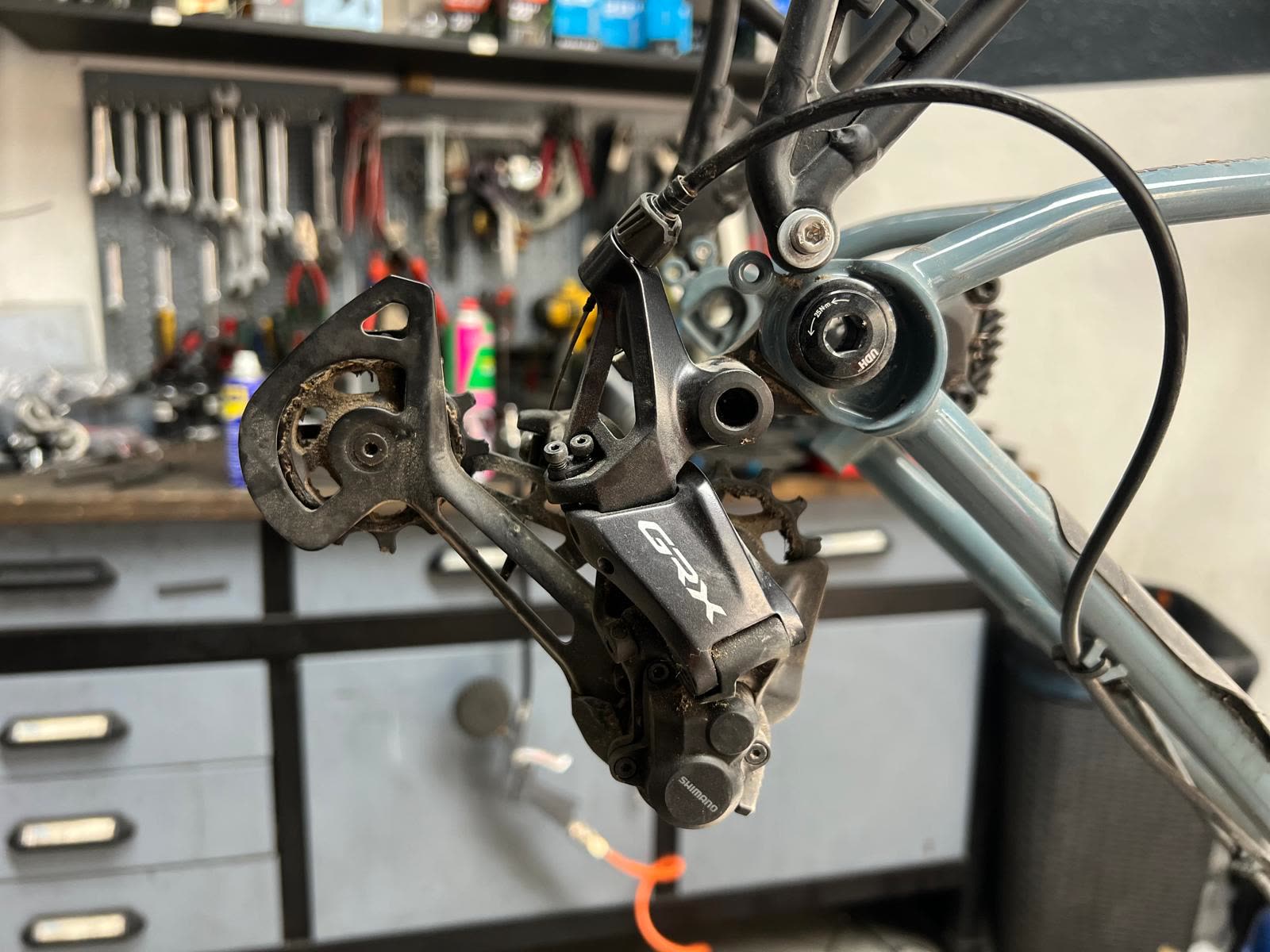
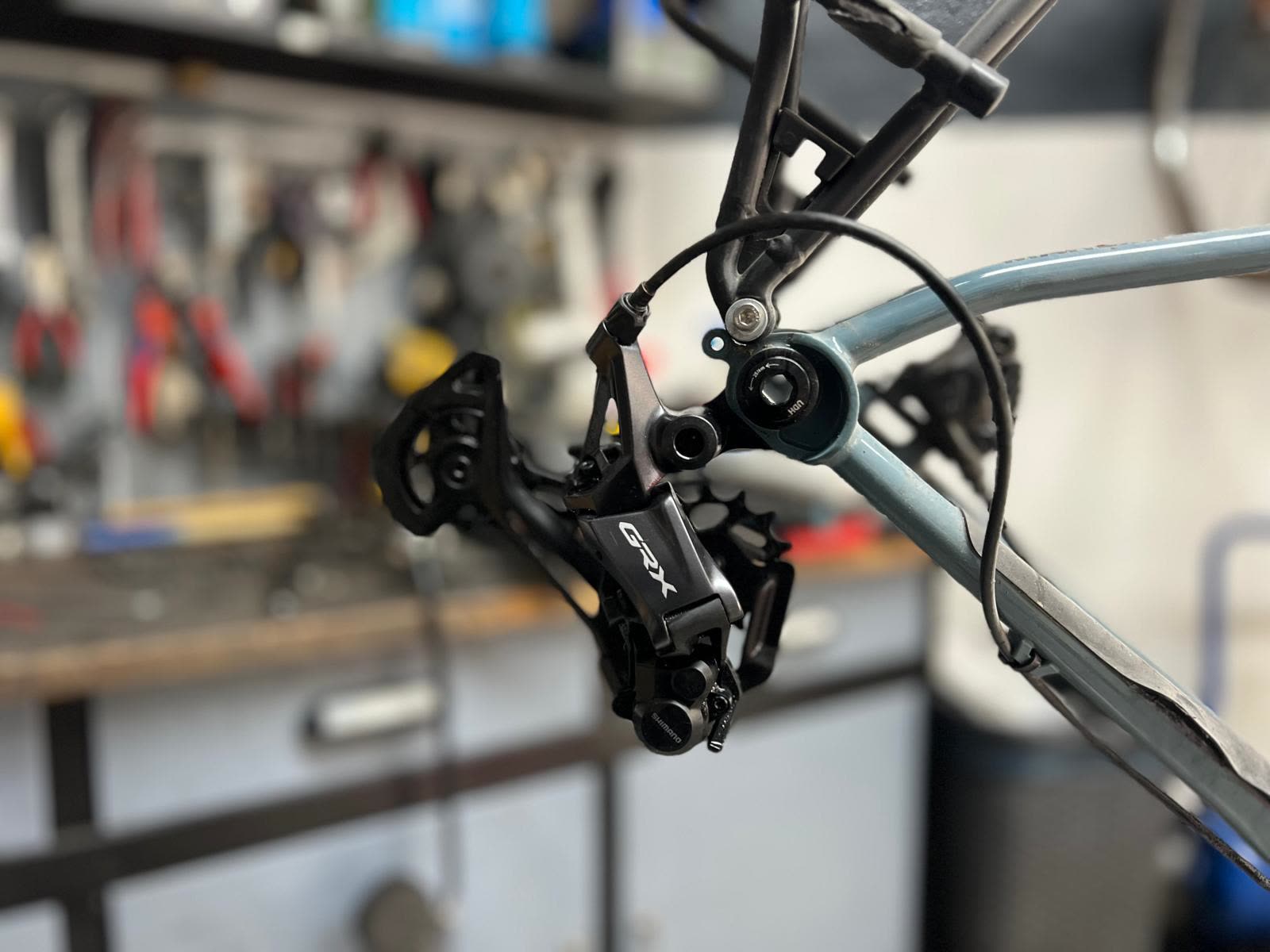
Workshop example: rear derailleur before / after cleaning
Why regular care pays off
Most repairs in our workshop could have been avoided. Worn chains that have already taken the cassette with them. Brake pads on metal now ruining the disc. Rusted-solid shift cables. All of it costs three to five times more than timely care. Rule of thumb: whoever invests 10 minutes in their bike every few weeks saves hundreds of euros long term. And the bike rides nicer, quieter and more safely.
The monthly routine: what you do yourself
Tyre pressure: use a pump (a floor pump is a must at home) to bring pressure to the recommended value, usually printed on the tyre sidewall. Too little pressure causes flats and slow rolling, too much makes the bike uncomfortable and can damage the tyre. Chain: wipe off roughly with a rag, apply thin fresh oil to the rollers (not the outside), turn the cranks backwards, wipe off excess oil. On city bikes every 4 weeks, more often for high-mileage riders. Lights & bell: function test. Bolts: check saddle and stem clamp firmness with an Allen key, but don't overtighten.
The yearly routine: what the workshop does
Once a year (e.g. in spring) the bike belongs in the workshop. We measure wear parts with tools you don't have at home: chain gauge, callipers, torque wrench. We check: chain wear, brake pad thickness, shift cables for rust and free movement, brake cables on mechanical systems, hydraulic brake bite point, wheels for wobble and spoke tension, all bearings for play (bottom bracket, headset, hubs), tyres for cracks and remaining tread. It takes about one hour of pure work, and at our shop costs from €29.95 including partial cleaning.
The 5 most common care mistakes
1. WD-40 as chain oil: WD-40 is a creeping oil and cleaner, not a lubricant. It dries out the chain and washes the existing oil away. Always use proper chain oil (wet or dry, depending on the season). 2. Over-oiling: dripping oil attracts dirt, which acts like sandpaper on the chain. Always wipe off excess oil with a rag. 3. Ignoring brakes until they scrape: riding with pads below 1 mm often destroys the rim or disc: a €5 spare turns into an €80 repair. 4. Using a pressure washer: high pressure shoots water and dirt into bearings and light contacts. Use a bucket, water and sponge instead. Bearings are ruined afterwards. 5. Never removing the seatpost: if the post sits in one position for months it can seize up. Once a year: pull it out, clean it, lightly grease it, refit.
Cleaning and lubing the chain: step by step
1. Wrap an old rag around the chain and turn the cranks backwards, which wipes loose dirt off. 2. If heavily soiled: chain cleaner or washing-up liquid with a brush, rinse with water and let it dry well. 3. Drop by drop apply chain oil to each roller (not to the outer plates) while turning the cranks slowly backwards. 4. Let it soak in for 5–10 minutes. 5. Wipe the entire chain again with a rag so that only the oil inside the pivots remains. The chain should look practically dry on the outside. Done wrong: too much oil on the outside → binds dirt → chain wears faster and smears your trousers.
Tyre pressure: the underrated lever
Wrong tyre pressure is the most common cause of flats and noticeably worsens handling. Recommended pressure is printed on the sidewall (e.g. "min 4.0 to max 6.0 bar"). Rule of thumb: city tyres 3.5–5 bar, trekking/cross tyres 4–6 bar, road bike 6–8 bar, mountain bike 1.8–2.8 bar. Check interval: every 2 weeks with a good floor pump with pressure gauge. Mini pumps for on the road do fine in emergencies but not for proper inflation.
Cleaning: how often and with what?
A full clean 2–4 times a year is enough for most city bikes. Method: bucket with warm water plus a little washing-up liquid or bike cleaner, soft sponge, brush for chain and cassette. Never a pressure washer. After drying, re-oil the chain: water has washed away the old oil. Forgetting to oil the chain after cleaning = rust within days. It's the most important step after every wash.
Frequently asked questions
How often should I oil the chain?
For normal city use every 300–500 km or once a month. Immediately after riding in rain and after every cleaning. A dry chain without oil wears 3–5× faster.
Which chain oil is good?
For city and commuting a standard chain oil with good adhesion. In winter a thicker wet lube (e.g. Finish Line, Squirt, Muc-Off). In summer a lighter oil is enough. Never WD-40, motor oil or universal oil.
How do I know my chain is worn out?
Hard to tell by eye: you need a chain wear gauge. We measure at every inspection free of charge. Replace at 0.75 % elongation. If replaced too late, the cassette and even the chainring are usually also worn, and the repair gets expensive.
Can I wash my bike with a garden hose?
Yes, as long as you don't use high pressure. A gentle stream is ok, then clean with a sponge, rinse, dry, oil the chain. A pressure washer shoots water into the bearings and destroys them.
How often should I go for an inspection?
At least once a year, ideally in spring. For high-mileage riders (daily commuters) twice. Advantage: small problems are caught early before they cause big damage.
Tools every rider needs
- Floor pump with pressure gauge
- Allen key set (3, 4, 5, 6, 8 mm)
- Chain oil (seasonally appropriate) and old rags
- Tyre levers and spare tube
- Multi-tool for on the road
- Optional: chain wear gauge and torque wrench
When was your last inspection?
Come by Friesenstraße 24, Berlin-Kreuzberg, mornings without an appointment. Inspection from €29.95.
Related guides
E-bike maintenance in Berlin: what the workshop does and what it doesn't
Brakes, gears, chain, inspection. What the workshop takes care of, and what it doesn't.
Read guide „E-bike maintenance in Berlin: what the workshop does and what it doesn't“Bicycle spring check: what to inspect after winter
Full post-winter checklist. Brakes, gears, chain, tyres, lights. Inspection from €29.95 in Kreuzberg.
Read guide „Bicycle spring check: what to inspect after winter“Winterproofing your bike in Berlin: the complete guide
Checklist, road-grit-salt care, lights, tyres, chain. Winter check from €29.95 at our Kreuzberg workshop.
Read guide „Winterproofing your bike in Berlin: the complete guide“